
When is a coin flip not a coin flip? The Monty Hall problem explained
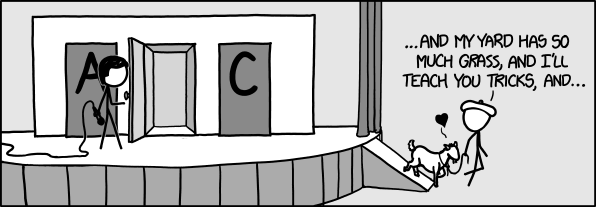
The Monty Hall problem is a thought experiment legendary for its counterintuitive solution. You’ve likely already seen it, but if not, here it is:
“Suppose you're on a game show, and you're given the choice of three doors: Behind one door is a car; behind the others, goats. You pick a door, say No. 1, and the host, who knows what's behind the doors, opens another door, say No. 3, which has a goat. He then says to you, ‘Do you want to pick door No. 2?’ Is it to your advantage to switch your choice?“
The intuitive answer is that switching doors makes no difference in the problem’s outcome. You’re choosing between one of two doors. One has a car and the other doesn’t. It’s a coin flip. I’ve already said that the true solution is unintuitive, though. And it is. Switching to the door you didn’t originally select will always increase your chances of winning. Why?
Before I continue, yes – switching is absolutely the correct solution. The problem has been repeatedly tested in real life, mathematical simulations have been run, and pigeons have even intuitively grasped the solution and gotten fat off of the rewards. There have been several attempts at explaining the reasons behind the correct answer, and I’m going to combine some of them in the hope that it makes for a rational and intuitive explanation.
I’d like to point out rules for this game show that, while often taken for granted, can help make sense of things when you’re reminded of them.
- The host knows what’s behind each door.
- When opening one of the doors you haven’t chosen, the host can’t open the door with the car behind it.
The show doesn’t work if these aren’t true. If the host initially opens a door to reveal the car, how can he offer you the opportunity to change your answer and still make a game of it?
- The car is behind a random door.
This is a statistics game, not a guessing game, regardless of how it may present itself.
With that out of the way, let’s begin.
Suppose you’re on a game show, and you’re given the choice of one million doors. Behind one door is a car; behind the other 999,999, goats. You pick a door, say No. 1; what are the odds of you having picked the correct door? Literally one in a million. You’re more than four times more likely to die from a meteorite impact than you are to have chosen the car. It stands to reason then that the odds of the car being behind one of the 999,999 unchosen doors is virtually guaranteed.
However, even though there’s a 99.9999% chance that these doors have the car, only one of them can have it hiding behind them. Hypothetically, if we were able to select the door from the 999,999 that would have the car if your original door does not have the car (which is, again, virtually guaranteed) then you would have two doors left: your original one-in-a-million-moonshot door, and the other door, which is where the car will be when your moonshot crashes and burns.
Anyway, the host, who knows what's behind the doors and can’t open the door with the car behind it, opens 999,998 of the doors you didn’t pick, and they all have goats. That leaves two doors: your original door, and, door, say, No. 420,068. He then says to you, ‘Do you want to pick door No. 420,068?’ Is it to your advantage to switch your choice?“
By opening all those doors, the host is making that hypothetical I brought up before a reality. Let’s consider your options before and after the doors opened:
Before, you had your unimaginably unlikely guess, and the near-guaranteed probability that the correct door was one of the many that weren’t your choice, but that probability was spread out between almost a million doors, so that high likelihood isn’t that beneficial.
After the doors swing open, you have your unimaginably unlikely guess, and you still have the near-guaranteed probability that the correct door was one you didn’t choose. This time, though, that’s only one door. Since the host can’t open your door, and he can’t open the door with a car behind it, if you failed to select the correct door initially, then in order to leave two available doors he has to open every door except for the one that holds the car. Switching seems prudent here.
Alright, but there are two doors left. Why is that not a fifty-fifty chance? Well, it would be – if you made your first choice when there were only two doors. But you made it when there were one million, and revealing information about other doors doesn’t change anything about your own unless you open every single one of the other doors. The probability of your door being right is still one in a million. The only thing that changed when the host opened almost one million doors is that the formerly spread out guarantee that the car is not your door has been condensed to just a single door.
Let’s return to the original problem. You’re given the choice of one of three doors, which means your guess has a one in three chance of being correct. Statistically, it’s very likely that your door has a goat. If this is indeed the case, after you make your selection the host will open one of the two remaining doors. Since the car must be behind one of these two doors, the host must open the door that doesn’t have the car. The door he left closed must therefore have the car. Switch.
But what if you did choose the correct door? In that case, which door the host opens is meaningless, so you should ignore anything he does. Stay.
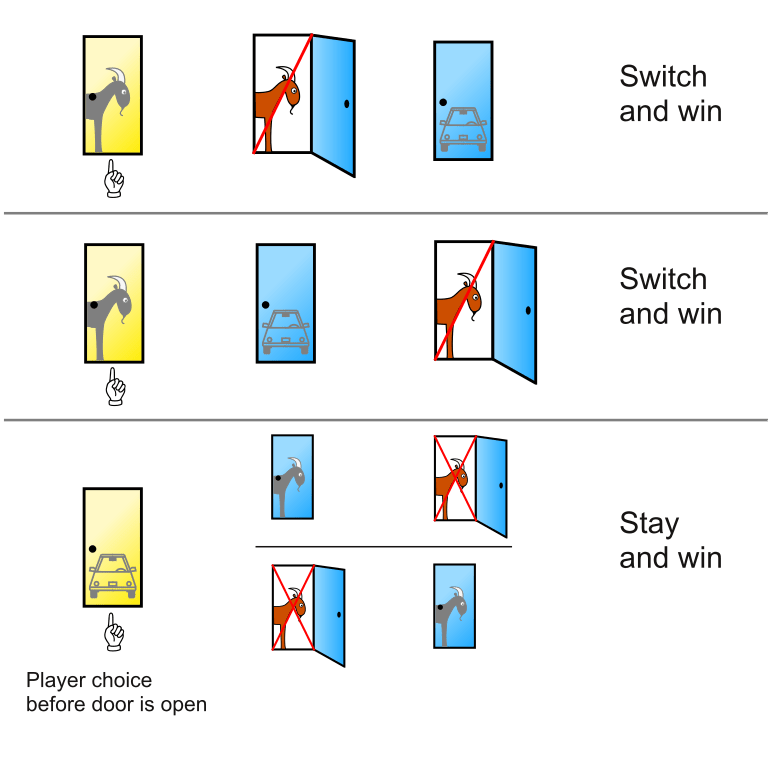
To summarize, if you initially chose the incorrect door, you force the host to leave the correct door closed, so you should switch to it and claim your prize. This happens two thirds of the time. If you initially chose the correct door, the host opens a meaningless door because you already have the car – you just don’t know it yet. This happens one third of the time.
But again, there are two doors left. It could be a complete coin flip and your choice doesn’t matter. Who knows? Oh, that’s right. The pigeons do.