
Why Gravity Slows Time: Relativity, Geometry, and Spaghetti
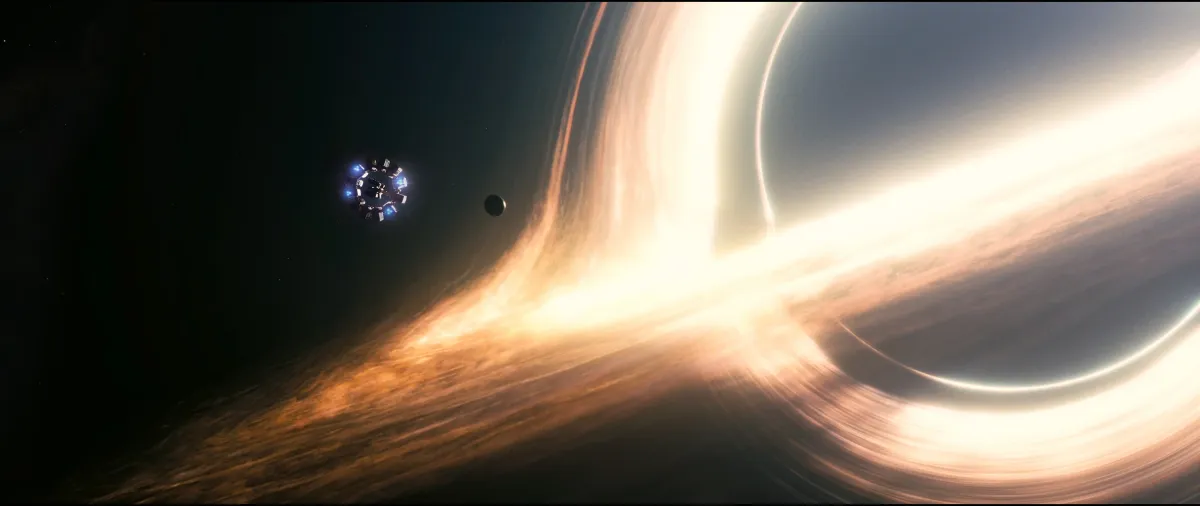
At this point, it's relatively well-known that black holes have an incredible effect on the passage of time. Just being near one can turn seconds into years. That one guy in Interstellar took a two-week vacation to a black hole, and when he got home, his ten-year-old daughter was in her eighties. Supposedly, this phenomenon is due to the intense gravity around these fallen stars. Intuitively, though, this makes zero sense. Why should an object pulling you in also make time slow down for you? Yes, according to the physics of general relativity, gravity is defined as the four-dimensional curvature of the geometric manifold that is the space-time continuum – the setting of our universe – and therefore affects time as well as space. But, crucially, this definition tells you nothing if you're not a nerd. It doesn't explain why our GPS satellites have to make micro-corrections to stay synchronized with the Earth (they experience slightly weaker gravity from Earth up there, so time moves faster for them; without those corrections, our devices would track their positions incorrectly, and we would get lost1), or why that one maneuver that same guy in Interstellar made cost him fifty-one years (his "maneuver" was falling into his vacation destination, which in real life costs you infinity years because you never come back, and it makes you taste great when tossed in aglio e olio because you will be spaghettified).
Here's my take on it.
What is Time? A Slice of Life
We live in three dimensions: length (up and down), width (left and right), and depth (forward and back). Using these three dimensions and their six associated directions, you can definitively describe any object's location in relation to yours. The light bulb of the lamp next to my desk? Up and to the right, and also a little bit behind me. The bee pollinating the flower below my window? Straight forward, and about ten feet down. The political landscape of many Western nations? Dangerously far right. However, even though we live in three dimensions, we exist in four. That fourth dimension is time, and even though it doesn't seem like it, time is another geometric dimension, not unlike2 length, width, and depth, just moving in directions (past and future) that happen to be completely perpendicular to our spatial dimensions.
We can't actually perceive time – not the way we can perceive space, at least. If we think of time as the axis of a graph, with points in the negative direction corresponding to the past, and points in the positive direction corresponding to the future, we can only ever observe one infinitesimally small point on that axis – whatever our "now" happens to be. You can look to the left, and you can look to the right, but you can never literally look to the past or the future; the only location in time you can ever look at is where you are, right now.
Here's a little tool I've made to demonstrate what this is like.
If it's acting strange or not working, you can click here to open the tool directly.
Imagine you're a two-dimensional being living on that sheet. You and your entire world are flat; you can only perceive what's on the infinitely thin layer that is your sheet, and that's all you'll ever be able to see; the image on the right is a representation of your 2D view. If an object passes through your world, but in the direction of the higher dimension you can't see, what does it look like? Let's start with a circle – a 2D-being just like you, but rotated in a dimension you can't understand. Play with the slider to move the circle up and down, and check out what the 2D version of you sees.
That circle, an exemplar of a 2D curve, is now only an infinitely thin, completely straight line to you, because it is now curving in a direction you can't see. Interestingly, the length of the line you see changes with the strength of the circle's curve in the perpendicular dimension. The wider the circle is at the point it makes contact with your world, the longer its line is. We aren't changing the size of the circle, but from our limited view, it's clearly a growing and shrinking line. The line never changes length in the full view, but moving the object in a higher dimension can change its length in our perceivable world.
Let's move over to the 3D option and take a look at the sphere. This is a fully three-dimensional object, so our 2D minds won't ever be able to see or visualize what it's truly like. Our 2D vision shows a circle of varying size, because an infinitely thin, circular cutout of the sphere is all that can ever be in our infinitely thin world at one time, and just like the perpendicular circle's line, the wider the sphere is at the contact point, the larger the circle we see.
This 2D-to-3D analogy carries over 1:1 to our own three-dimensional existence. We too have a higher physical dimension we can only ever occupy one infinitesimally small slice of. Unlike in the demo, though, instead of objects moving up or down through our slice of reality, we are the ones moving. No matter what, we always move up in that perpendicular direction to our normal ones. Or in other words, we always move forward in time. At its core, time is just an additional, special direction that things in our universe go in. It's as much a direction as up, left, or forward, but we can't choose to move in it, just like how a square can't choose to leap off the page it lives in.
For me personally, one thing always comes to mind when I think about that dimensional analogy: if we can only exist in and see our exact location in time, what exactly is memory? Well, to answer that, in the 3D mode of the tool, adjust the slider so that the sphere is all the way at the top. Then slowly move it down through our 2D sheet, and take note of the size of the circle it makes at different sphere heights as it passes down through our slice of reality – or, relatively speaking, as we move up through it. Our 2D selves only ever saw one slice of the sphere at a time, but we now have a progressive record of the size of the sphere's circular slice as it fell through our plane. If that sheet is our 3D world, and the vertical direction is time, then we kept a record of an event (the sphere) at different points in time as we moved forward in time through it. We were never able to see more than one point in time at once, but if we put those slices together, we can reconstruct a precise record of what the event was like when we existed in the time that it happened. That's how we can store information of the past without being able to look back into the past itself. That's memory. Every moment in time, our brains store a snapshot of the universe around us so we can access previous points in time without needing to see them.
And what did all that have to do with the original question?
Okay, great. So we know time is a direction we have no control over, and we know we can perceive time as much as a person chained to a booth in the Times Square Applebee's can see New York City: technically, yes, you're looking at NYC, but practically, you're just looking at microwaved entrees and people who started drinking at 11 am. But what does that have to do with gravity, and why does that relationship mean that gravity slows down time?
Our universe itself is a four-dimensional shape, like that 3D sphere but if you gave it another dimension and then unwrapped it into a 4D blanket that was almost, but not quite, perfectly flat. We live in an infinitely thin thread of that blanket (for a 4D observer, not for us; in our native three dimensions our slice is as wide as the universe), and even though our thread is pretty wrinkly, we'll never see the resulting curves for the same reason that if you crumpled a piece of paper with a 2D guy on it, he wouldn't know what was happening, but he would probably still feel really weird and then throw up.
If our universe is a 4D shape, and we live in a 3D slice of it, then that means that curving the universe in 4D will mess with our reality in the same way that we could change the length of that straight line in 2D by moving a circle up and down. This happens more than you would think because there are actually things in our universe that can cause its 4d shape to bend.
The different things that warp the universe are (this is 100% real, not a joke):
- Pressure, like the air and water pressure used in pneumatics and hydraulics
- Negative pressure, like the tension in a rubber band (this bends the universe the opposite way that the other things do. It's all very scientific.3)
- Momentum (if you're fast enough and/or heavy enough, rotating yourself can actually twist the universe around you like you're a fork in spaghetti.)
and
- Literally all of the mass and energy that exists everywhere ever.
It turns out our universe is wrinkly because everything in it wrinkles it. Who knew?
None of these sources of wrinklage are very strong on their own, but if you get enough of any one of them, they can cumulatively add up to wrinkles so large that whoever's in charge of our reality might even consider ironing us. We see this the most in large clumps of mass like planets, stars, and black holes.
If you gather enough mass, momentum, energy, or rubber bands to create a very large four-dimensional curve, even though we can't perceive the curve itself, we can definitely observe how it makes our three-dimensional reality weirder.
Oh look – another tool! How did that get there?
This time around, let's assume from the very beginning that our flat sheet is analogous to the three dimensions we know, and that the upward and downward direction in this simulation is representative of time. A little blue ball (that's you!) is navigating the surface of an object with 4D curvature (that's our universe!). An important caveat, however: the universe is a 4D shape, but there's nothing outside the universe. As a result, when making calculations, treating the "global up" (the upwards direction in the room containing the simulation here) as the direction of time doesn't actually work because points of reference can only be within the actual universe. Instead, the direction of time is only up wherever there is universe for that to be possible. This means that instead of holding up a ruler in that room and saying, "every notch in this ruler is one second," you have to paint the notches onto the curvature itself. This turns out to make quite the difference.
Note: this representation of our 4D universe is extremely simplified. To be more accurate, it would need to be flipped upside-down and then aligned at a wobbly upward angle, among other things.
The first thing you might notice when looking at our dimensionally-stunted "4D" room is that in order to cross from one side of the object to the other, we need to move up and down to accommodate the object's curvature. It seems simple enough, until you start thinking about the implications of an entity needing to travel across a section of the universe that has been bent out of shape in order to reach its destination. What happens from a three-dimensional perspective when you cross a four-dimensional divot?
To an observer not in the divot with you, the same "push" appears to move you less than it moves them. You moving the slider is actually scrubbing through a paused animation I ran of the ball moving up and around the curvature. I launched the ball with just enough starting momentum at its position to make it all the way around the curve, but if I were to unwrap that curve so it were only in 3D (2D, in this simulated case) and launched it with the same force, it would have gone farther in what we, watching both balls, perceive to be the same amount of time. You can click on the button that gives the ball a friend to actually observe just how much farther it would have gone without it having to move through a dimensional divot.
This ball is not traveling less distance because pushing objects that are sitting in 4D dents imparts less force; it's traveling less distance because it's moving slower in time. This happens due to the way that objects with mass bend the fabric of our universe. Objects massive enough to measurably warp reality, like whatever it was in the simulation that pushed our 4D space into a semi-cylinder, don't create more "universe" to accommodate the curve. Instead, the universe stretches.4 You may recall that the imaginary notches we drew are on the curvature itself. When that curvature stretches, so do the notches, which causes them to be farther apart. This means that in this warped section of the universe, seconds take longer to elapse because seconds have been physically stretched longer. You don't notice anything strange when you're in the stretched area because you can't see into the time axis and notice that seconds are getting lengthier, but to people outside the warped area looking in at you, people whose seconds are not stretched nearly as much, it looks like you're living life in slow motion. And to you, their notches are very close together, so their seconds are shorter than yours; they look like they're being fast-forwarded. This is the effect on time we're looking for.
But how is this caused by gravity?
Nothing in the universe can be truly stationary. Even if you somehow found a way to make yourself completely still relative to every object in existence (which is impossible), you'd still be moving forward in time. This means that no matter what you do, you are always moving within our four-dimensional reality at some velocity. And since you're bound to that shape, you have to follow its curves, wherever they may take you. The thing is, just like a 2D man watching a circle being moved up and down through his slice of life, we can never see 4D curves, only 3D straight lines. As we know, these curves are primarily created by large masses. The direction of the curve is almost always inwards towards the mass that created it. This means that, everywhere in the universe, there are 4D curves hidden from us in a dimension we can't visualize, all leading to whatever large body created each curve. What does this mean for us, as three-dimensional entities that are always moving within the fabric of reality? Well, if there's a large body of mass to your right, and you try to move past it in a straight line, you'll find that your "straight line" actually sent you quite a bit to the right. This is because that massive object invisibly curved the universe in 4D in a way that crumpled our 3D environment. The end result? True straight lines follow the 4D curvature of that object, so straight lines look curved, because the definition of a straight line has been changed for us. Stay completely still if you want, and you'll still find yourself moving in the direction of that object, because you're still moving in the time axis, and the uneven curve the object creates means that your movement in time also moves you in space, and following that curve leads you directly to its source. This is what gravity is. It's not a pull; it's matter changing the local definition of a straight line so that all straight lines point to them. Gravity is the name of any four-dimensional curve in our universe, and since large curves – or strong gravity – stretch out the universe so that even seconds are lengthened, gravity slows time.
That's all there is to it. I do want to share one more interesting thing about black holes, though. They slow time so much for objects in their close proximity because their curves are stretching seconds out to years. However, they also change the local definition of a straight line, just like anything else with gravity. The difference, the thing that makes a black hole a black hole, is that once you get within a certain distance of one, the curvature at your location becomes so strong that every straight line in every direction you can look or travel just leads directly into the center of the black hole. In three dimensions, we interpret this as an inescapable pull inwards, but in four dimensions we can see the truth: once you've crossed the event horizon, that point of no return, the black hole physically no longer has an exit for you. Even if you could resist the pull by moving at infinite speed, it wouldn't matter. What direction would you blast off in, if every direction is the center of the black hole?
All roads lead to spaghetti.
If you enjoyed these dimensional analogies, or if you want them explained in a way that actually makes sense, check out the book Flatland by Edward A. Abbott (the A stands for Abbott. I'm serious). It was written in 1884, it's a fun read about a flat square who meets a new friend, and it's also a satirical novella on Victorian society. Read it for free here.
Footnotes
- Technically, because moving extremely quickly also affects time, our GPS satellites experience a time slowdown too, but it's not enough to offset how much faster the reduced gravity makes their clocks run. Funnily enough, GPS satellites are some of the best examples of the real-world applications of Einstein's monumental contributions to physics. It's thanks to special and general relativity that we don't have to use maps to get around everywhere
- Relative to the other axes, time is mathematically considered to be of the opposite sign, and rotating purely around the time axis like you would around the x, y, and z axes actually just corresponds to changing your relative speed. However, it's technically called a Lorentz boost, not a rotation, because the presence of multiple perpendicular axes and the non-Euclidean nature of space-time means that it's not exactly the same.
- While not incorrect, it would take an unfathomable amount of unfathomably long indestructible rubber bands stretched with unfathomable tension to ever warp the fabric of the universe by a noticeable amount.
- Disclaimer for physicists: I know spacetime isn't made of anything and that there's therefore no substance to stretch. However, just like the oft-invoked balloon analogy for the universe's expansion, a stretchy material is an excellent way to intuitively translate metric tensor adjustments in gravity wells.
Works Cited
Einstein, A. (1916). Die Grundlage der allgemeinen Relativitätstheorie [The foundation of the general theory of relativity]. Annalen der Physik, 49(7), 769–822. https://doi.org/10.1002/andp.19163540702
Minkowski, H. (1909). Raum und Zeit [Space and Time]. Jahresbericht der Deutschen Mathematiker-Vereinigung, 18, 75–88.
Schwarzschild, K. (1916). Über das Gravitationsfeld eines Massenpunktes nach der Einsteinschen Theorie [On the gravitational field of a mass point according to Einstein’s theory]. Sitzungsberichte der Königlich Preußischen Akademie der Wissenschaften (Berlin), 189–196.
Pound, R. V., & Rebka, G. A., Jr. (1959). Gravitational red-shift in nuclear resonance. Physical Review Letters, 3, 439–441. https://doi.org/10.1103/PhysRevLett.3.439
Vessot, R. F. C., Levine, M. W., et al. (1980). Test of relativistic gravitation with a space-borne hydrogen maser (Gravity Probe A). Physical Review Letters, 45, 2081–2084. https://doi.org/10.1103/PhysRevLett.45.2081
Ashby, N. (2003). Relativity in the Global Positioning System. Living Reviews in Relativity, 6(1), 1. https://doi.org/10.12942/lrr-2003-1
Will, C. M. (2014). The confrontation between general relativity and experiment. Living Reviews in Relativity, 17, 4. https://doi.org/10.12942/lrr-2014-4
Lense, J., & Thirring, H. (1918). Über den Einfluss der Eigenrotation der Zentralkörper auf die Bewegung der Planeten und Monde nach der Einsteinschen Gravitationstheorie. Physikalische Zeitschrift, 19, 156–163.
Everitt, C. W. F., et al. (2011). Gravity Probe B: Final results of a space experiment to test general relativity. Physical Review Letters, 106, 221101. https://doi.org/10.1103/PhysRevLett.106.221101
Kruskal, M. D. (1960). Maximal extension of Schwarzschild metric. Physical Review, 119(5), 1743–1745. https://doi.org/10.1103/PhysRev.119.1743
Rees, M. J. (1988). Tidal disruption of stars by black holes of 10^6–10^8 solar masses in nearby galaxies. Nature, 333, 523–528. https://doi.org/10.1038/333523a0
Optional (near–black-hole gravitational redshift showcase):
Abuter, R., et al. (GRAVITY Collaboration). (2018). Detection of the gravitational redshift in the orbit of the star S2 near the Galactic centre massive black hole. Astronomy & Astrophysics, 615, L15. https://doi.org/10.1051/0004-6361/201833718