
Why is your eye twitching, and how can you stop it?
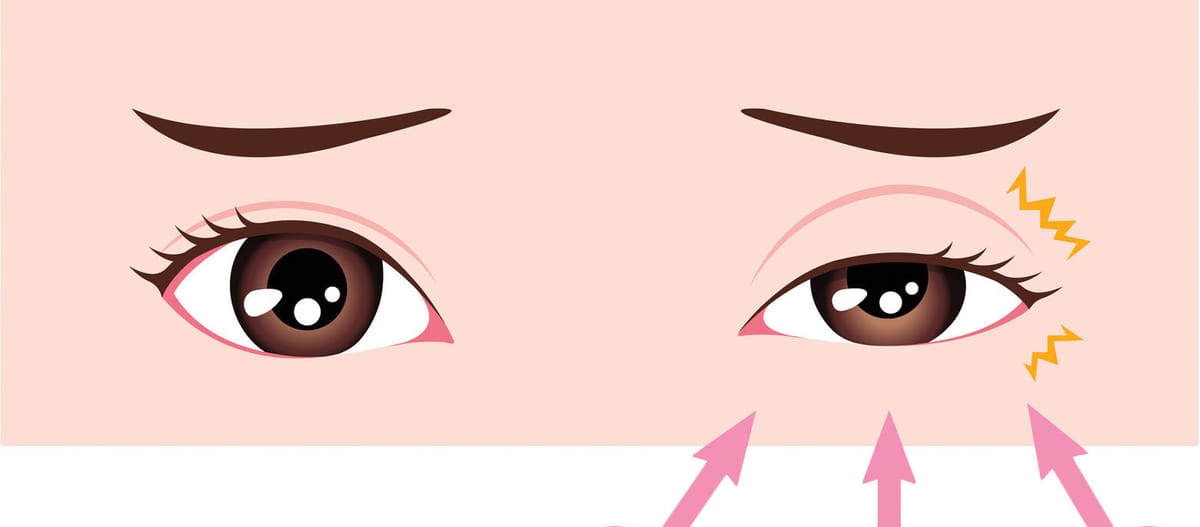
At some point in your life, you’ve probably felt your eyelid start twitching uncontrollably. It’s not exactly a pleasant sensation. From personal experience, I’d liken it to having my lower lid experiment with alternative movement patterns beyond the standard “open” and “close.” When your face starts ticking like a metronome, should you be concerned? Are you getting sick? Is there anything you can do?
Well, no, kind of, and sort of. The medical term for this type of involuntary muscle spasm is eyelid myokymia, and it’s thankfully benign in almost all cases. A twitching eyelid can provide you with valuable information about your general state of health, though. While its cause isn’t completely understood, eyelid myokymia has been strongly linked to sleep deprivation, fatigue, stress, and caffeine overconsumption1 – so much so that it’s earned the moniker “medical students’ disease.” Fittingly, nearly half of medical students get twitchy during exam week, a time of sleepless nights, mounting dread, and a blood-Monster Energy level of 0.1%. So if you’re spasming like you’ve been cramming for your infectious disease final, it’s worth thinking about how well you’ve been sleeping, how heavy your workload has been, what your caffeine intake has been like, and how many patches of your own hair you’ve ripped out recently.
How eyelid myokymia appears to an observer. Credit: Wikipedia
Thankfully, this kind of myokymia is quite easy to cure. You just need to invert whatever it is that’s contributing to the twitch. Get some sleep if you’ve been running on empty; switch to tea if you’ve been over-reliant on coffee; cut the drama out of your life if it’s been affecting your blood pressure. If you unfortunately cannot treat the source of your problems, however, there are alternatives you may be able to try. Gently stretching your lower eyelid by pulling it down and holding it there has been shown to provide temporary relief, and if all else fails, botox is remarkably effective at shutting down both voluntary and involuntary eyelid movements. It also has the added benefit of making you shine like a radiant, wrinkle-free alien.
DISCLAIMER – If you experience any of the following:
- The twitching does not resolve within a few weeks.
- Twitching develops in other parts of the face.
- There is difficulty opening the eye.
- There is complete eyelid closure with each twitch
- Redness or swelling of the eyelid
- Drooping of the eyelid
THAT IS NOT STANDARD EYELID MYOKYMIA. GO TO THE DOCTOR. DO NOT PASS GO. DO NOT COLLECT $200.
Footnotes
- All four of these factors result in excessive activation of the sympathetic nervous system and production of cortisol and other stress neurotransmitters. Combine that with the reduced reuptake that occurs during periods of sleep deprivation, and you have a good recipe for neurotransmitters hanging around where they aren’t supposed to be, activating neurons and muscle fibers that aren’t supposed to be activated. Research on the topic is still ongoing.